Solar Panel Cleaning Equipment
Showing the single result
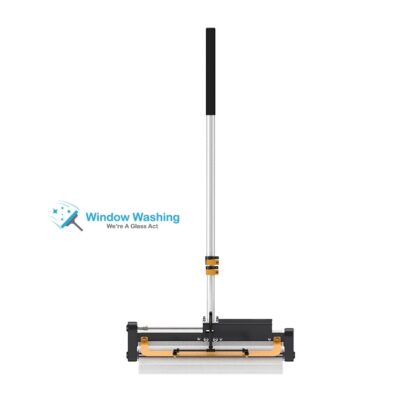
Solar panel cleaning equipment for South African conditions: a telescopic rotating brush machine that reaches roof-mounted arrays from the ground on a 7.5 metre pole, mains powered through an AC/DC converter. It costs R18,450 including VAT. It uses a soft rotating brush and purified water — the only method that cleans a panel without risking the anti-reflective coating it depends on.
Telescopic solar panel cleaning machine
One machine: a 60 cm rotating roller brush on a 7.5 metre telescopic aluminium pole, long enough to reach single-storey, double-storey and commercial pitched-roof arrays from the ground. It runs on 240 V mains through a 24 V DC converter, so it keeps going for as long as it is plugged in: 7.5m pole kit, mains powered (R18,450).
Why brush and pure water, and nothing else
The anti-reflective coating on a photovoltaic panel is a few microns thick and it is the reason the panel converts as much light as it does. Anything abrasive removes it permanently, and anything high-pressure drives water past the frame seals into the laminate. That rules out pressure washers, scouring pads and scrapers — see can you clean solar panels with a pressure washer.
It also rules out detergent, which leaves a film that attracts dust faster than the panel collected it in the first place. A soft rotating brush lifts the dust; purified water carries it away and dries leaving nothing behind.
The water is half the job
Panels are cleaned to raise output, so cleaning them with water that dries to a mineral haze is self-defeating. South African municipal supplies typically run 100 to 400 ppm of total dissolved solids; you want the water below 10 ppm before it touches the glass.
- 75 GPD reverse osmosis system — R4,360
- Reverse osmosis water trolley — R17,050, filtration and transport together
- TDS meter — R290, confirms the water is actually pure and tells you when a membrane is spent
More on how purified water is produced and measured: what water do window cleaners use.
How often solar panels need cleaning in South Africa
It depends on the province more than the panel. Inland, Karoo and Highveld arrays pick up dust quickly and benefit from a clean every three to six months. Coastal installations get more rainfall and often stretch to twelve. Arrays near gravel roads, farmland or construction sites need more attention than either. Bird droppings sit outside any schedule — they shade cells completely and should be removed as soon as they appear.
Method, timing and what to avoid: how to clean solar panels.
Buying solar panel cleaning equipment for a business
Solar panel cleaning is recurring work, which makes it better business than once-off cleaning, and the equipment overlaps almost entirely with window cleaning — the pole, pump, RO system and trolley are shared, and only the brush head differs. If you already run purified water for glass you are most of the way there. See what you need to start a solar panel cleaning business, or the full window cleaning equipment range.
We courier nationwide from Cape Town and all prices include VAT.