
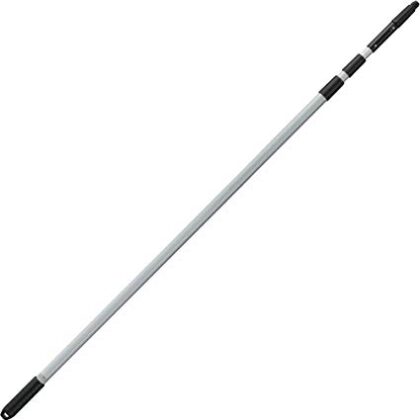
Window cleaning equipment for high windows falls into two families: telescopic poles, which carry a squeegee or washer head up to the glass and cost R770 to R1,720, and waterfed poles, which pump purified water up the shaft to a brush and start at R5,170. The dividing line is roughly three storeys — above that, a squeegee on a pole stops being controllable and pure water becomes the only practical method.
Match the reach to the building
Buy for the tallest window you actually clean, not the tallest you can imagine. A 9 metre pole weighs meaningfully more at full extension and is slower to work with on a single-storey house.
| Storeys | Working height | What to use | From |
| Ground / shopfront | to 2m | 2 metre telepole | R770 |
| Single | to 4m | 4 metre telepole | R1,090 |
| Double | to 6m | 6 metre telepole or 6m waterfed pole | R1,500 |
| Triple | to 9m | 9m fibreglass waterfed pole | R8,970 |
Why ladders stop being the answer
Above single storey a ladder needs a second person footing it, level ground, and somewhere to stand that is not a flowerbed or a driveway. It also has to be repositioned for every pane. Pole work removes all three constraints: the operator stays on the ground, moves along the elevation continuously, and can work alone. On a double-storey house that is usually the difference between a two-hour job and a forty-minute one.
Most commercial contracts now specify ground-based cleaning outright, which makes a pole system a condition of bidding rather than a convenience.
Telescopic pole or waterfed pole
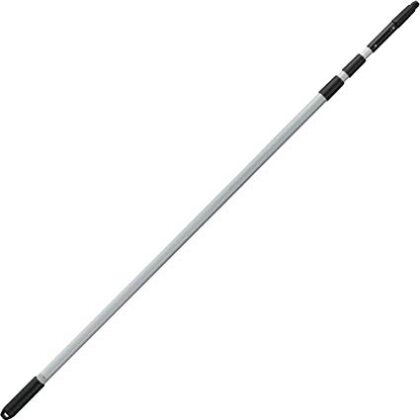
A telescopic pole holds a squeegee or washer and you clean exactly as you would by hand, just further away. It is cheap, needs no water supply, and works well to about 6 metres. Past that, controlling the blade angle from the ground gets difficult and the finish suffers.
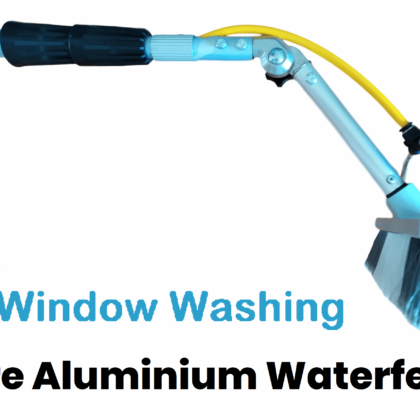
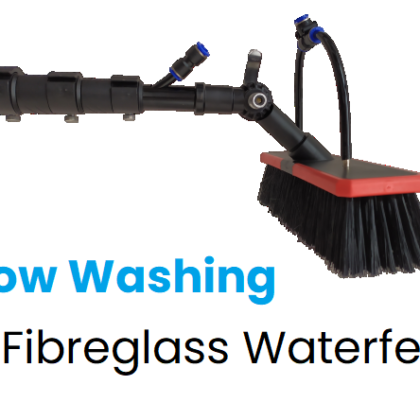
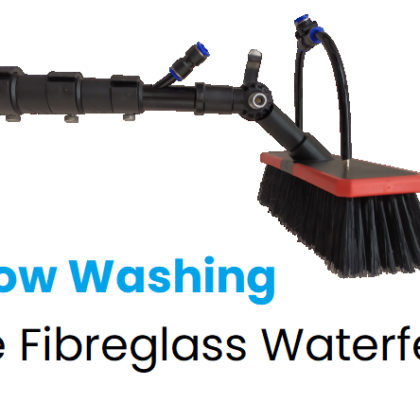
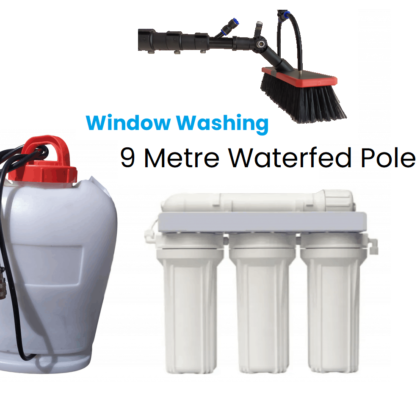
A waterfed pole feeds purified water through the shaft to a brush head. Because the water has had its dissolved minerals stripped out, it dries without leaving marks — so there is no squeegee stroke to control and no finishing required at height. That is what makes 9 metres practical.
What the pure water side costs
- 75 GPD reverse osmosis system — R4,360, produces the purified water
- Deionised water supply — R3,500, mobile resin polishing
- TDS meter — R290, confirms the water is actually pure enough
- 15 litre electric mobile pump — R4,710, pressure without a mains tap
- Reverse osmosis water trolley — R17,050, filtration and transport in one
Complete packages that pair the pole with its water supply: the 6 metre waterfed pole kit at R14,560 and the 9 metre waterfed pole kit at R16,660.
High-reach equipment for commercial buildings
For contract work on office blocks and retail parks the specification changes in two ways. First, the water supply has to travel with you — a trolley system rather than a tap connection, because you cannot rely on finding an outside tap on a commercial site. Second, carry spares: a nicked rubber or a contaminated brush will streak an entire elevation, and reworking it costs more than the spare did.
See the full window cleaning equipment range, or tell us how many storeys you clean and we will size it for you.