
No. A pressure washer should not be used on solar panels. Most manufacturers put the safe limit somewhere near 34 bar (500 psi) and a domestic pressure washer starts at roughly four times that. The risk is not the glass breaking outright — it is the anti-reflective coating being scoured off, and water being driven past the frame seals and the junction box, where it causes corrosion and delamination months later. Nearly every panel warranty excludes damage from high-pressure cleaning.
What actually goes wrong
Three separate failures, in rough order of how often they happen:
- Coating damage. The anti-reflective layer is microns thick. Stripping it reduces output permanently — the opposite of the reason you cleaned the panel.
- Seal intrusion. Water forced under the frame sits against the cell laminate. This shows up as browning or bubbling at the panel edge, usually a season later.
- Thermal shock. Cold water on a panel that has been in the sun all day means a sudden temperature drop across a sheet of tempered glass with cells bonded to it. Microcracks do not announce themselves; output just drops.
What to use instead
The method that works is the same one used on high windows: a soft rotating brush fed with purified water, on a pole, from the ground. The brush lifts dust without abrading the coating, and because the water carries no dissolved minerals it dries without leaving the marks that would cut output further.
Our solar panel cleaning equipment range is built around exactly that: telescopic rotating brush machines and pole kits in 3.5m, 5.5m and 7.5m lengths, in mains, battery and dual-power versions.
-
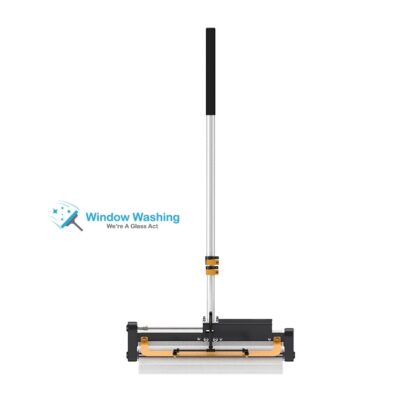
3.5m Pole Kit – Mains Powered (AC/DC Converter) Rotating Solar Brush Cleaner
R20057,00 -
3.5m Pole Kit – Dual Power Version Rotating Solar Brush Cleaner
R24098,00 -
3.5m Pole Kit – Lithium Battery Powered Rotating Solar Brush Cleaner
R23088,00 -
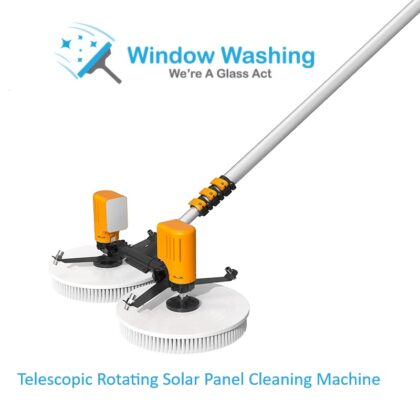
Telescopic Rotating Solar Panel Cleaning Machine 3.5m Dual Power Supply
R24202,49
When to clean, and how often
Clean early morning or late afternoon when the panels are cool, never in the middle of a hot day. In the drier parts of South Africa, dust accumulation is heavy enough that a scheduled clean every three to six months is usually worth it; in wetter coastal areas rainfall does more of the work and an annual clean may be enough. Bird droppings are the exception — they shade cells completely and should come off as soon as you see them.
What about a garden hose
A hose is safe from a pressure point of view, but on its own it will not clean the panel and the tap water will dry to a mineral haze that costs you output. If you are going to wet the panel, use purified water and a brush.
See the full window cleaning equipment range, which shares the same pole and pure water systems.